
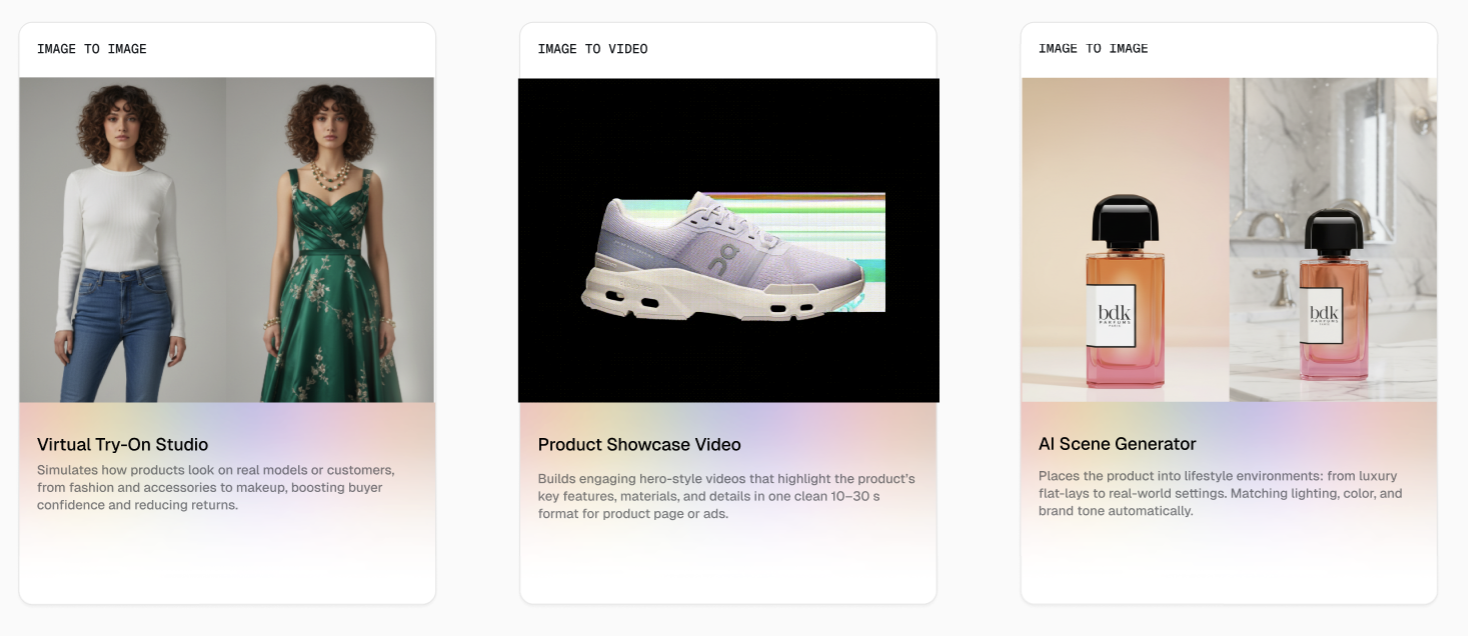
E-commerce is shifting fast. What used to require designers, copywriters, and agencies can now be automated by Generative AI. Today, product cards, visuals, and campaigns are created in minutes, not weeks, with full brand consistency.
Large Language Models (LLMs) and Generative Media Models form the foundation of this new creative economy. Together they let e-commerce brands build text, visuals, and videos automatically while keeping control over tone, quality, and speed.
With platforms like FlyMy.AI, this transformation is becoming accessible to any business. Through one API, companies can connect open-source and custom models, scale creative workflows, and cut GPU infrastructure costs by up to 70 percent.
Online retail generates more data and content than ever. Each product needs unique descriptions, SEO metadata, high-quality images, and localized versions for different markets. Producing all this manually is slow and expensive.
Generative AI solves that. LLMs and visual generation models can write, design, and localize at scale. They create thousands of product cards, ads, and landing pages while keeping messaging aligned with the brand.
Modern shoppers expect speed and personalization. With AI, e-commerce teams can react instantly to trends, update visuals for new seasons, test ad variations, or launch product videos in hours.
LLMs generate and optimize text for every part of your e-commerce workflow. They:
This makes your content faster, smarter, and multilingual without extra hiring or outsourcing.
Generative models handle the visuals that convert visitors into buyers. They:
These models help brands keep creative output fresh while cutting studio and photoshoot costs. Instead of hiring models, brands can train a custom LoRA of their ambassador or style and use it across visuals and campaigns.
FlyMy.AI brings both text and media generation together in one infrastructure. Through a single API, businesses can:
It’s a plug-and-play system built for developers and marketing teams alike.
1. Product Visual Automation
Combine visuals and products to create new content. For example, upload your catalog and use FlyMy.AI to generate lifestyle photos for every SKU.

2. Quality Enhancement
Use upscaler tools to improve image resolution and uniformity for marketplaces like Amazon or Shopify.
3. Virtual Ambassadors
Train a virtual brand face with Flux Trainer and use it in campaigns, social posts, or interactive videos.
.png)
4. AI Video Ads
Create and resize video ads for each platform with text-to-video models like WAN 2.2 or MiniMax Hailuo.
5. 360-Degree Product Views
Use image-to-video generation to create rotating product clips for landing pages or AR apps.
6. Social Media UGC
Produce unlimited short videos and user-style content for Instagram, TikTok, or YouTube using FlyMy.AI Effects.
Brands like Zara, Nike, and Shopify-based stores already apply similar automation, cutting their production time by 10x while launching faster global campaigns.
LLMs create text, and generative models produce visuals.
Together they form a complete automation pipeline from product naming to final marketing video.
FlyMy.AI merges both systems under one architecture, enabling full creative automation, seamless model orchestration.
This combination turns creativity into a scalable process rather than a bottleneck.
E-commerce is entering its intelligent era.
AI doesn’t replace creativity, it scales it.
With FlyMy.AI, every e-commerce brand can turn its catalog into an infinite creative engine.
1. What is the cost to start using AI in e-commerce?
Begin with one workflow and expand once you measure ROI. FlyMy.AI allows small-scale trials before scaling production.
2. Is integration complex?
No. FlyMy.AI provides plug-and-play APIs for text and media generation compatible with any CMS or backend.
3. How do I ensure tone and brand accuracy?
Use well-defined prompt templates and LoRA fine-tuning for your content style.
4. Which is better: open-source or managed AI?
Open-source models give flexibility, but managed AI from FlyMy.AI ensures reliability, scalability, and cost optimization