FLUX LoRA Training: FlyMy.AI vs Fal.ai vs Nano Banana
Which platform keeps a face recognizable under strong style shifts? We trained the
same LoRA on three providers and measured identity fidelity and prompt adherence.
By Valentin Kovalev, Denis Timonin and the FlyMy.AI ML teamJuly 20265 min read
At FlyMy.AI, we position ourselves primarily as an infrastructure
startup - but behind that, our ML team continuously pushes the boundaries of
LoRA training in terms of quality,
speed and consistency. To evaluate where we stand,
we benchmarked three popular options for FLUX LoRA training and image generation
with face preservation: FlyMy.AI, Fal.ai and
Google Nano Banana.
Methodology
To ensure fairness, we applied:
Identical dataset (10-20 photos)
Flux dev as the base model
1,000 training steps
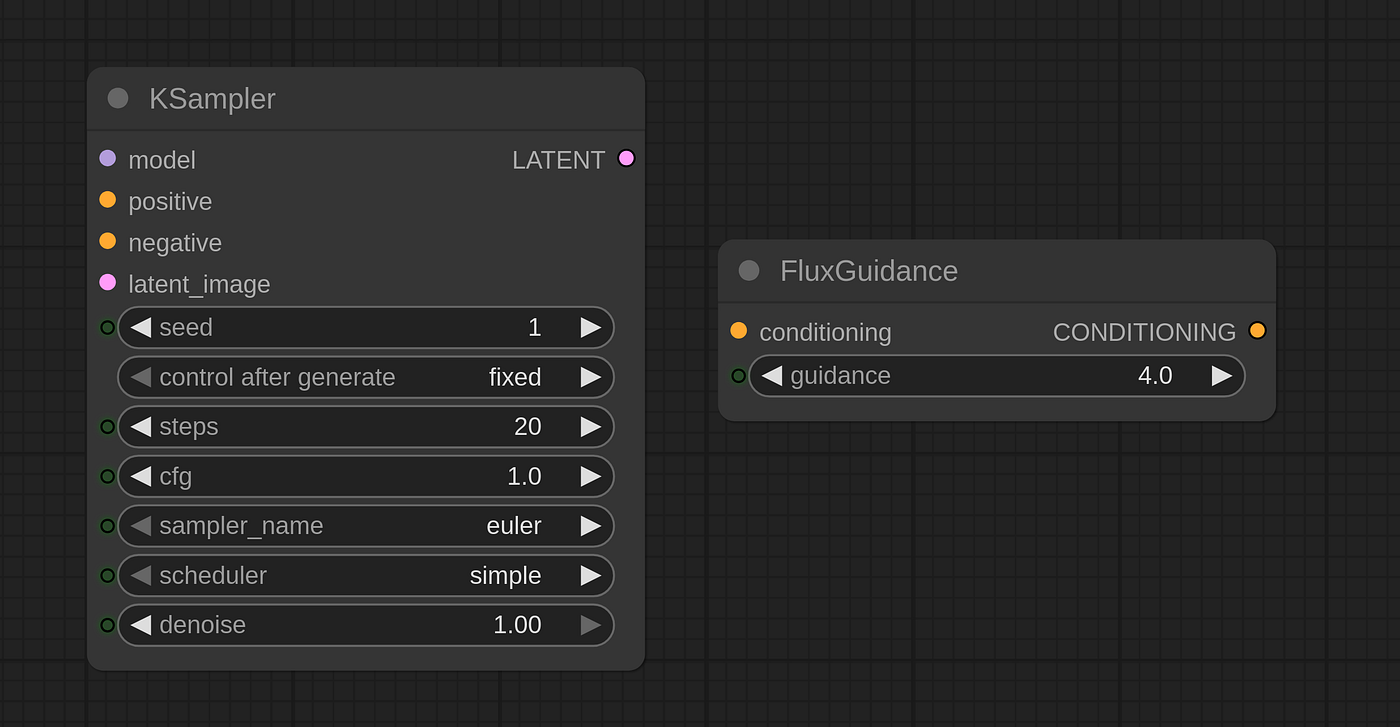
Standard inference parameters in ComfyUI with FluxGuidance = 4 and CFG = 1
The central question was simple: which platform best preserves identity under style shifts?
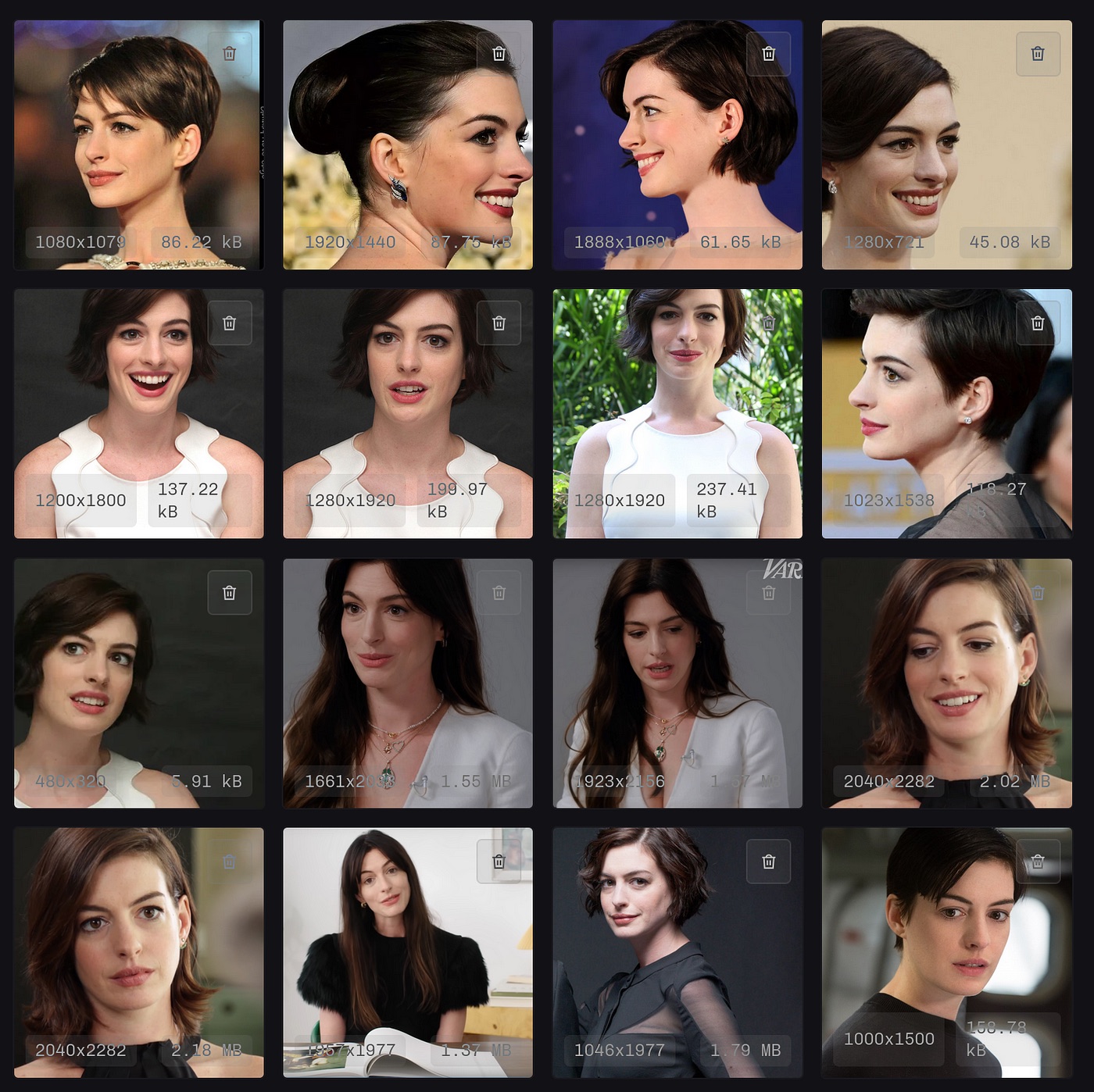
Image dataset of Anne Hathaway. Identical datasets of 10-20 photos were used across all tests, with Flux as the base model and 1,000 training steps.
Prompt-by-prompt comparison
Below, each panel shows the same prompt generated by FlyMy.AI and Fal.ai
(Flux + trained LoRA) and by Nano Banana (image edit).
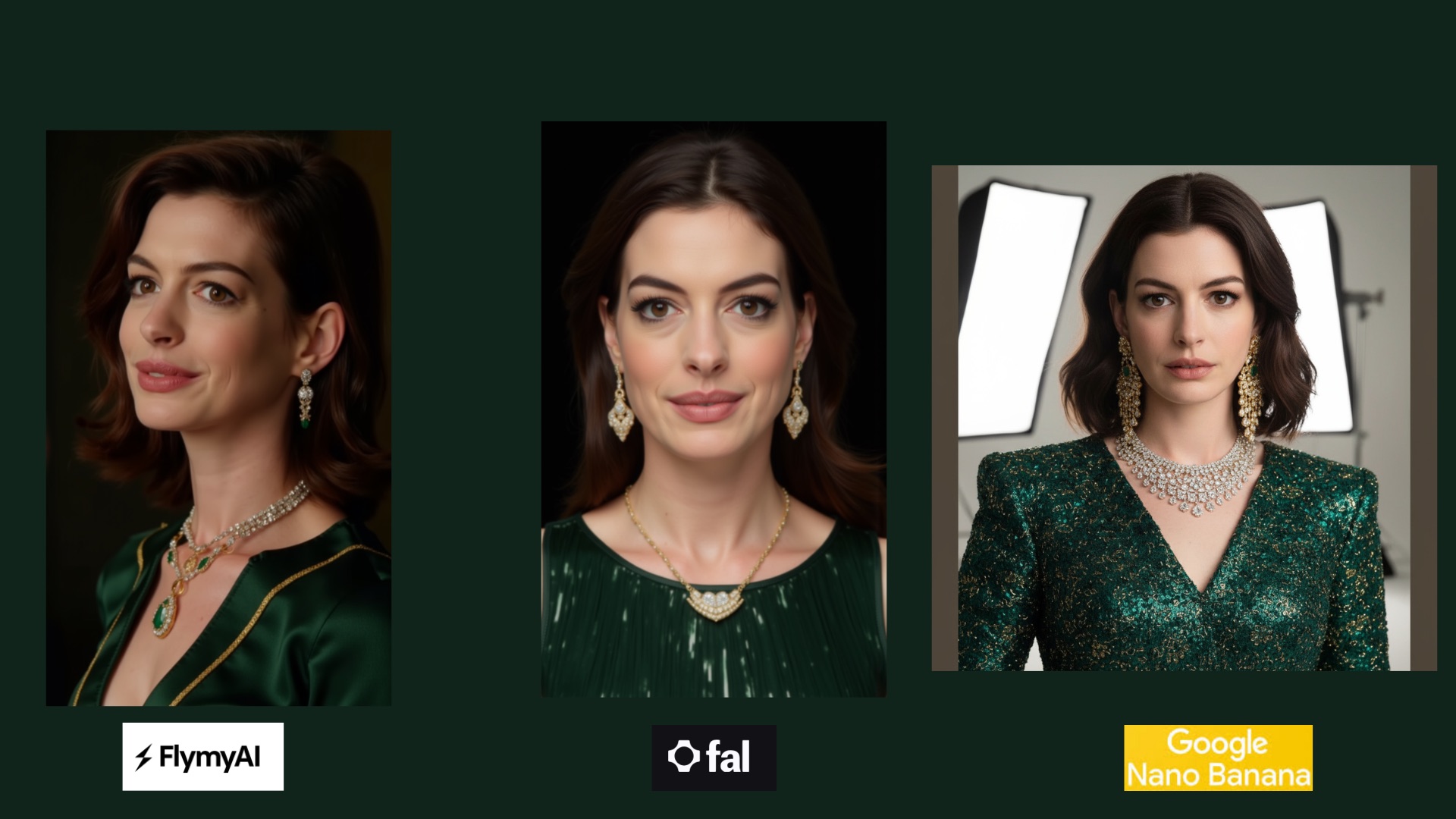
woman {trigger_word} face close up she is wearing luxurious dark green dress with shiny threads huge gold earrings in her ears beautiful diamond bracelet on her neck on the background of studio for photo shoot woman ohwx dramatically looking at camera as in photo shoot
Fal outputs often depict the subject as older, with increased wrinkles and an elongated facial structure, while Nano Banana results skew younger, with noticeable variations in eye shape and head proportions.
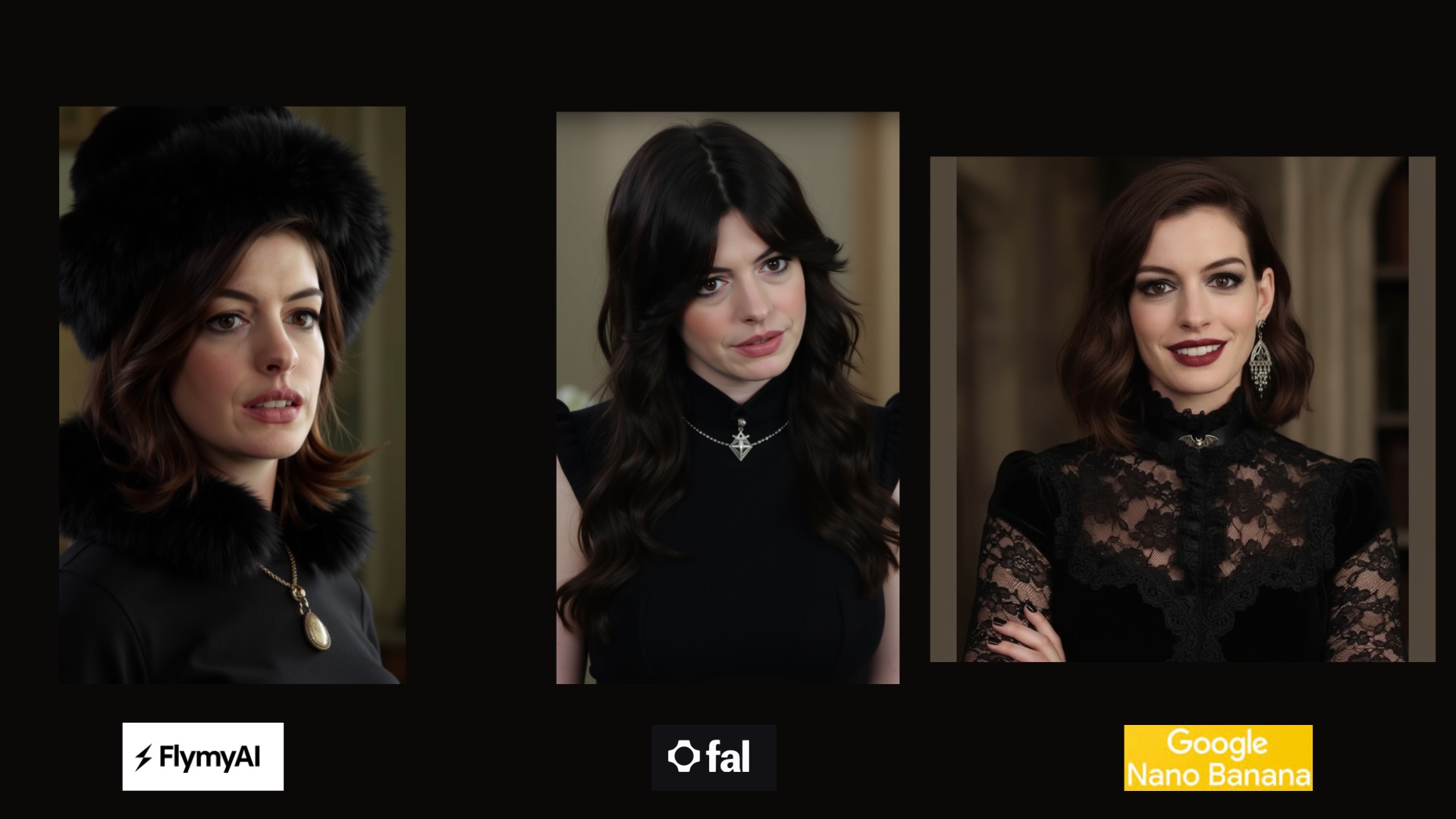
woman {trigger_word} close up gothic clothes
Fal outputs show noticeable facial shape alterations, while Nano Banana generations introduce artificial makeup and exhibit reduced facial fidelity compared to the original subject.
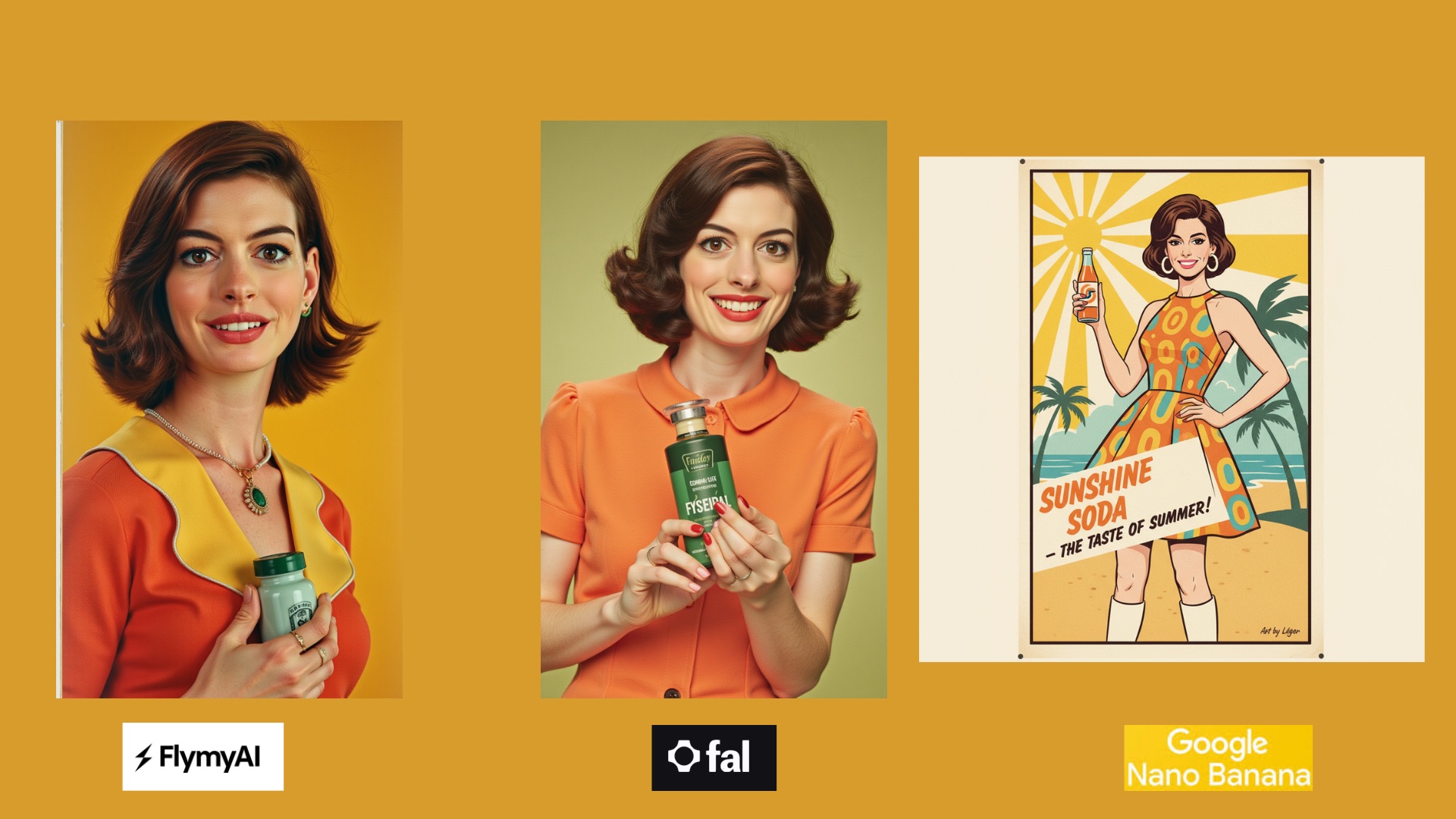
{trigger_word} woman as a vintage poster model, retro advertising style, wearing 1960s fashion, holding a product, classic poster design, nostalgic illustration
In Fal outputs, the generated woman shows little resemblance to the original subject, while Nano Banana results fail to follow the prompt, shifting instead toward a stylized, illustrated appearance.
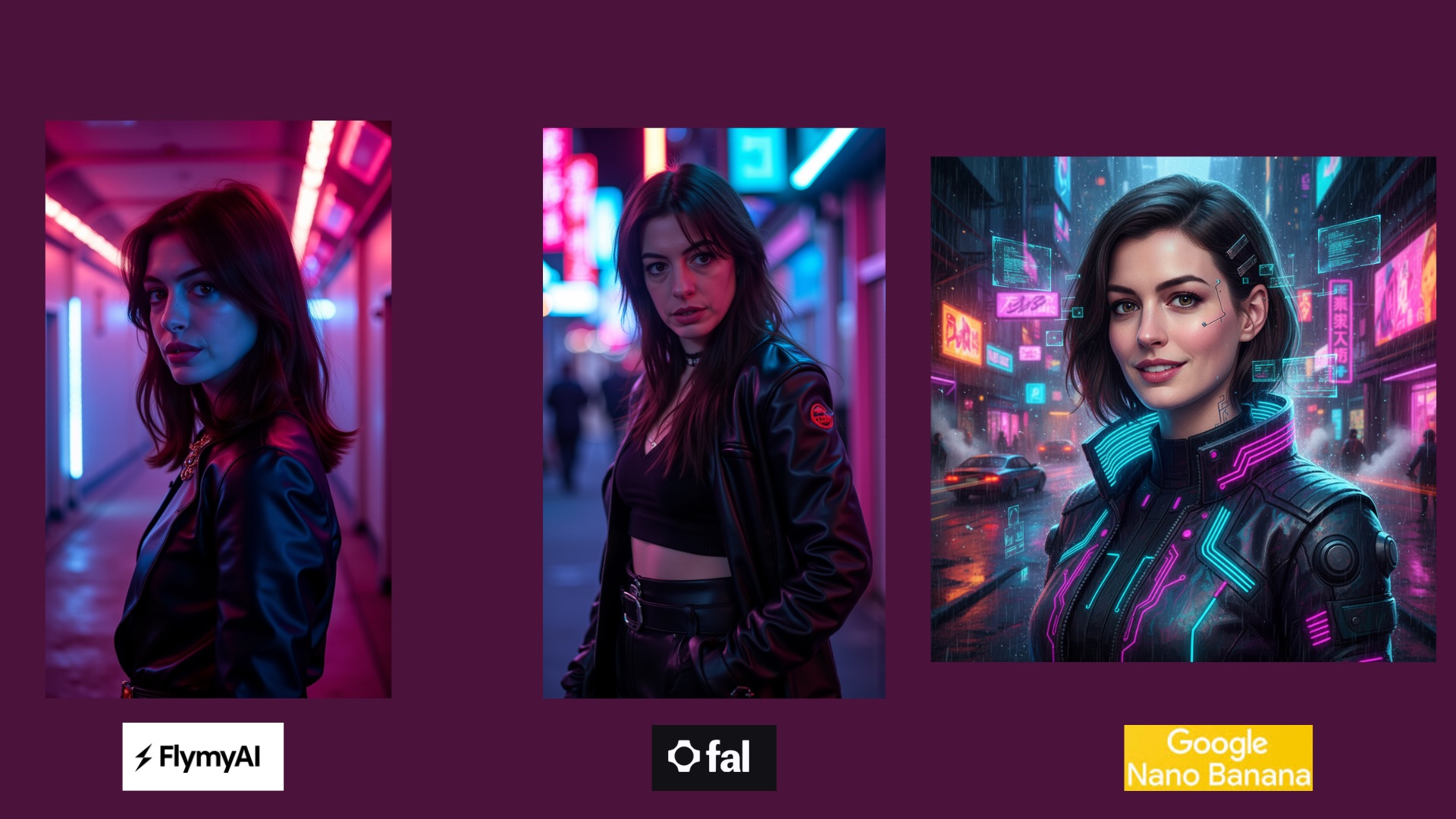
{trigger_word} woman close up in a cyberpunk aesthetic, neon lighting, holographic elements, wearing futuristic clothing, standing in a neon-lit alley, sci-fi atmosphere, digital art
Fal generations show minimal resemblance to the target identity, whereas Nano Banana outputs show poor prompt adherence, drifting toward an illustrated, stylized aesthetic.
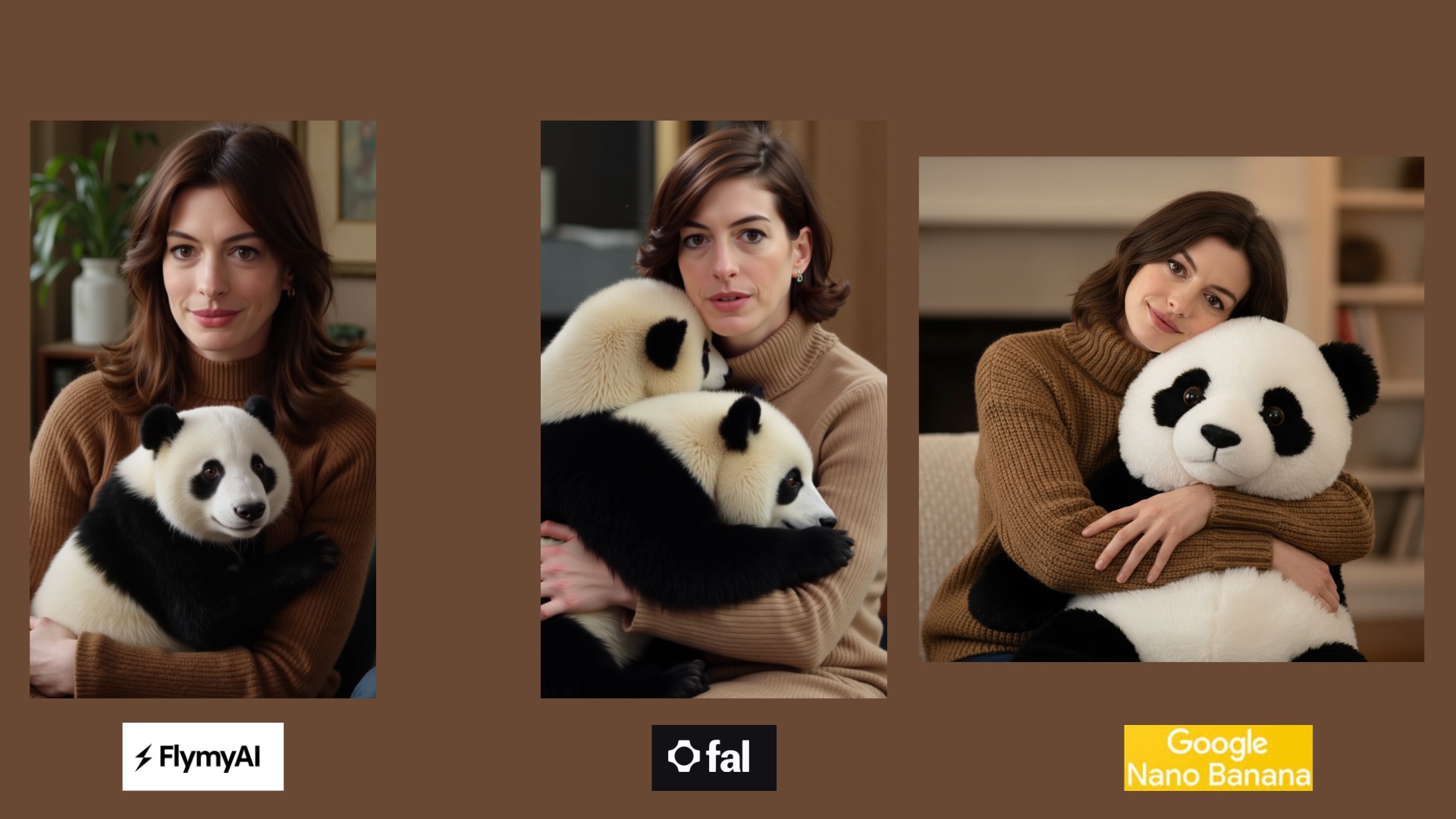
Close-up of {trigger_word} woman in brown knitted turtleneck sweater. Sitting with big black and white panda, hugging it, looking at camera
Fal outputs display a face that diverges significantly from the original identity, with additional artifacts in both the generated animal and prompt adherence. Nano Banana results also show weak prompt following, with the panda rendered more like a plush toy than a real one.
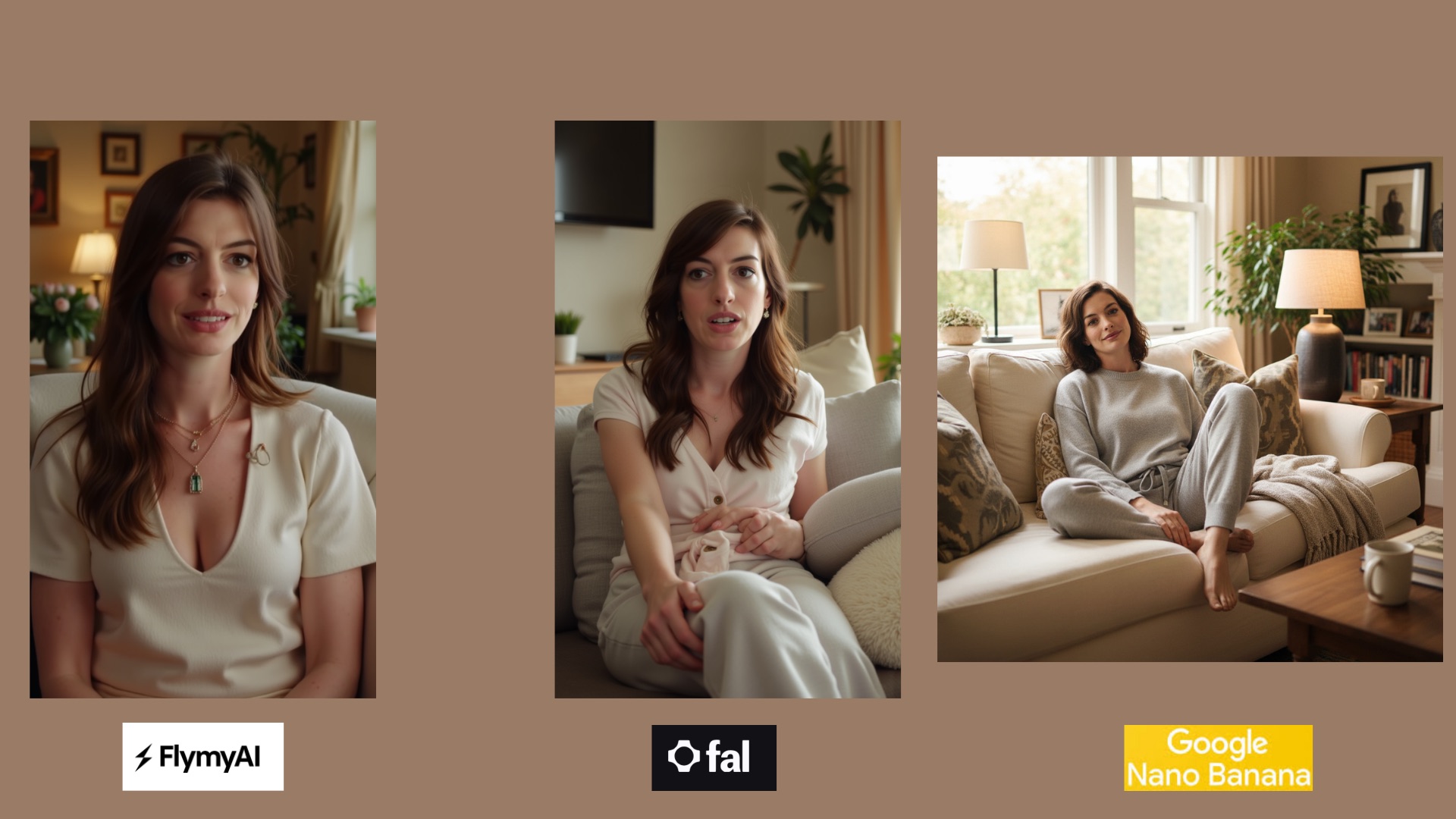
{trigger_word} relaxing at home, wearing comfortable loungewear, sitting on a sofa in a well-lit living room, domestic setting, warm lighting, photorealistic, lifestyle photography
Fal generations introduce artifacts in body proportions, particularly in the hands and fingers, while Nano Banana outputs depict a person whose appearance diverges entirely from the original subject.
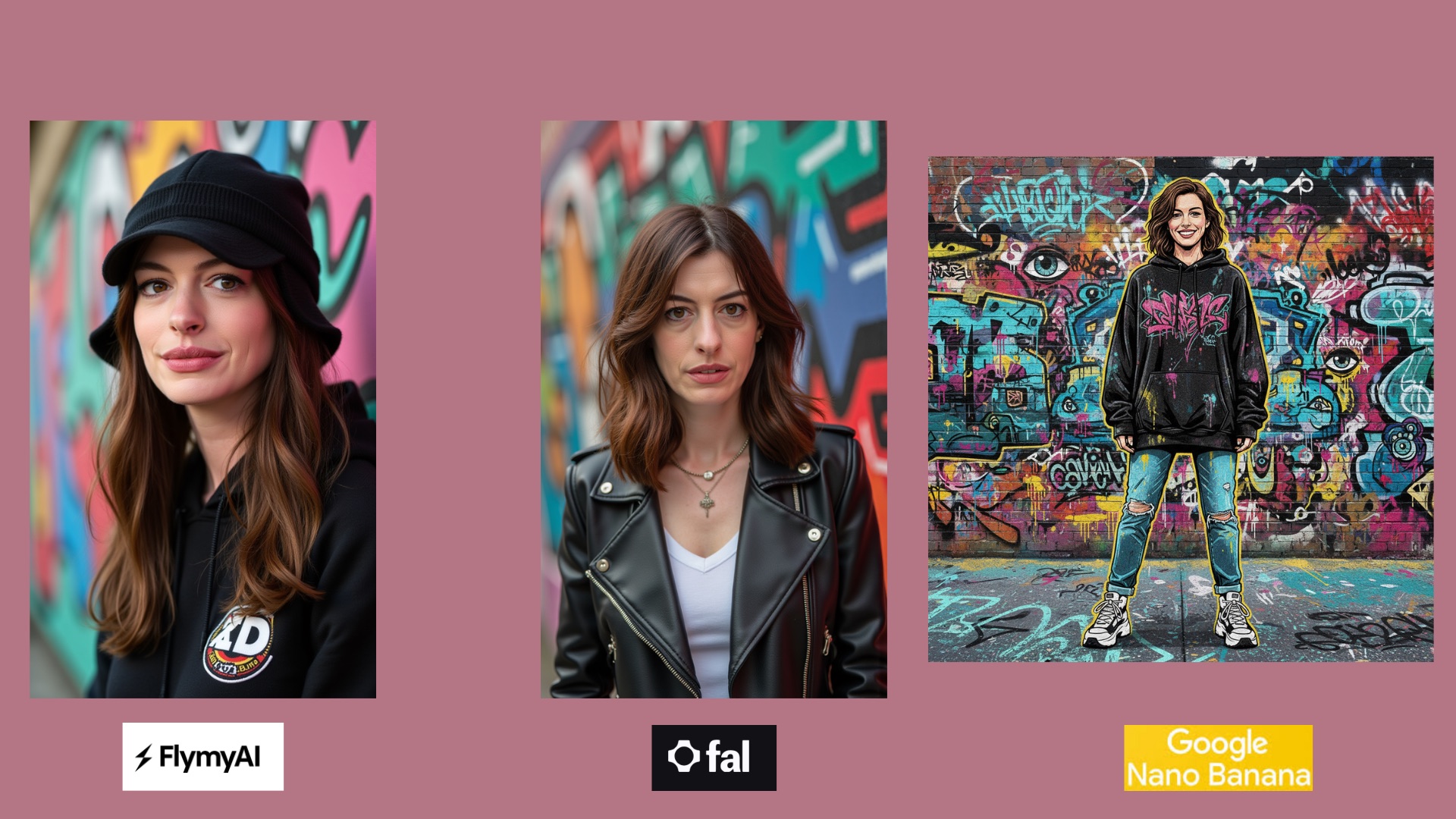
{trigger_word} woman close up in a street art style, graffiti background, wearing urban streetwear, standing in front of colorful murals, street art aesthetic, urban culture
Fal generations portray the character as significantly older than the original, with a noticeably elongated facial structure, while Nano Banana outputs shift the character into a different visual style altogether.
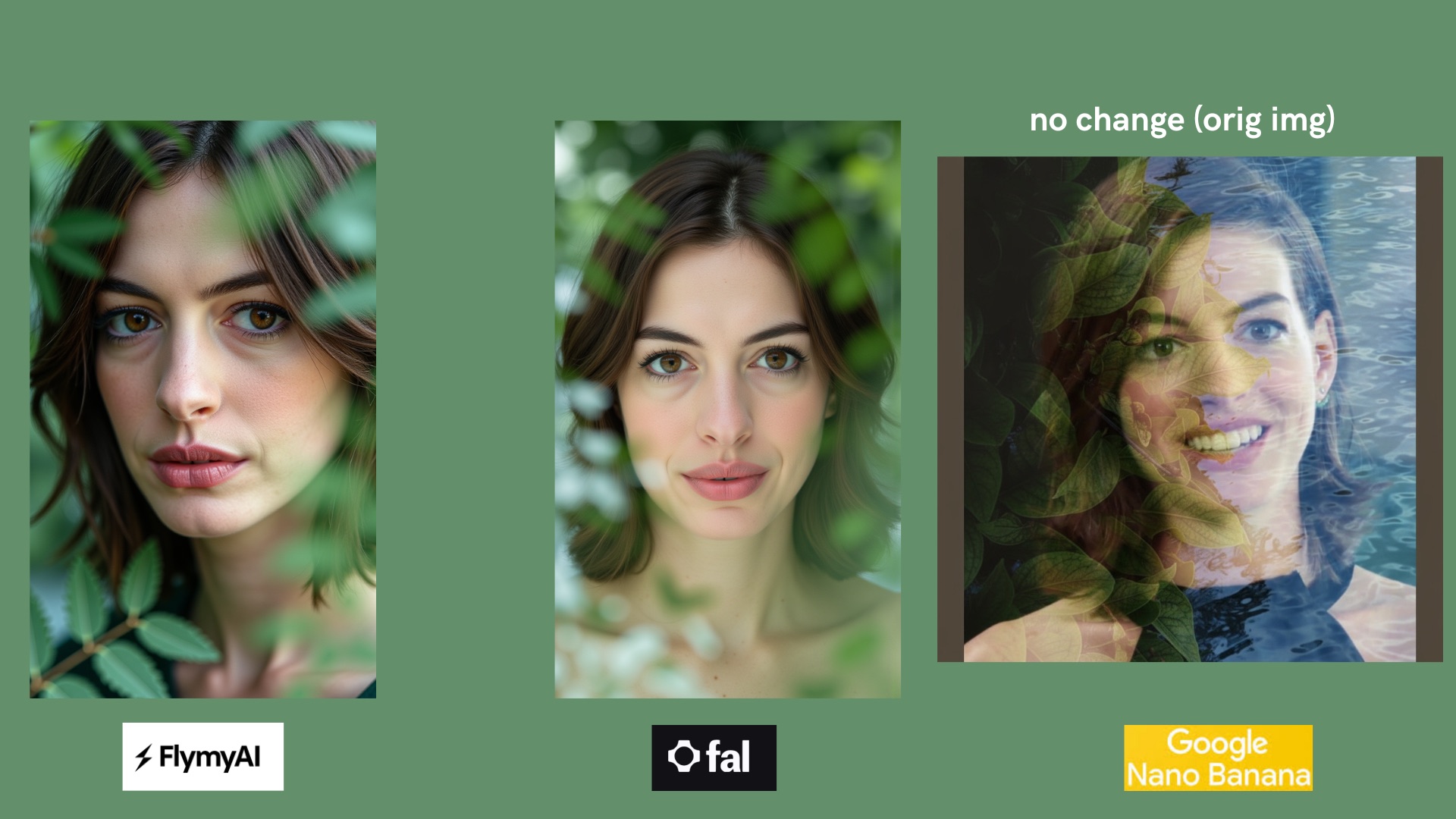
{trigger_word} woman Perfectly symmetrical young female face close-up, presented with double exposure overlay blending nature textures like leaves and water
Fal outputs produce a face that differs noticeably from the original identity, while Nano Banana results regress to a generic face and show little to no prompt adherence.
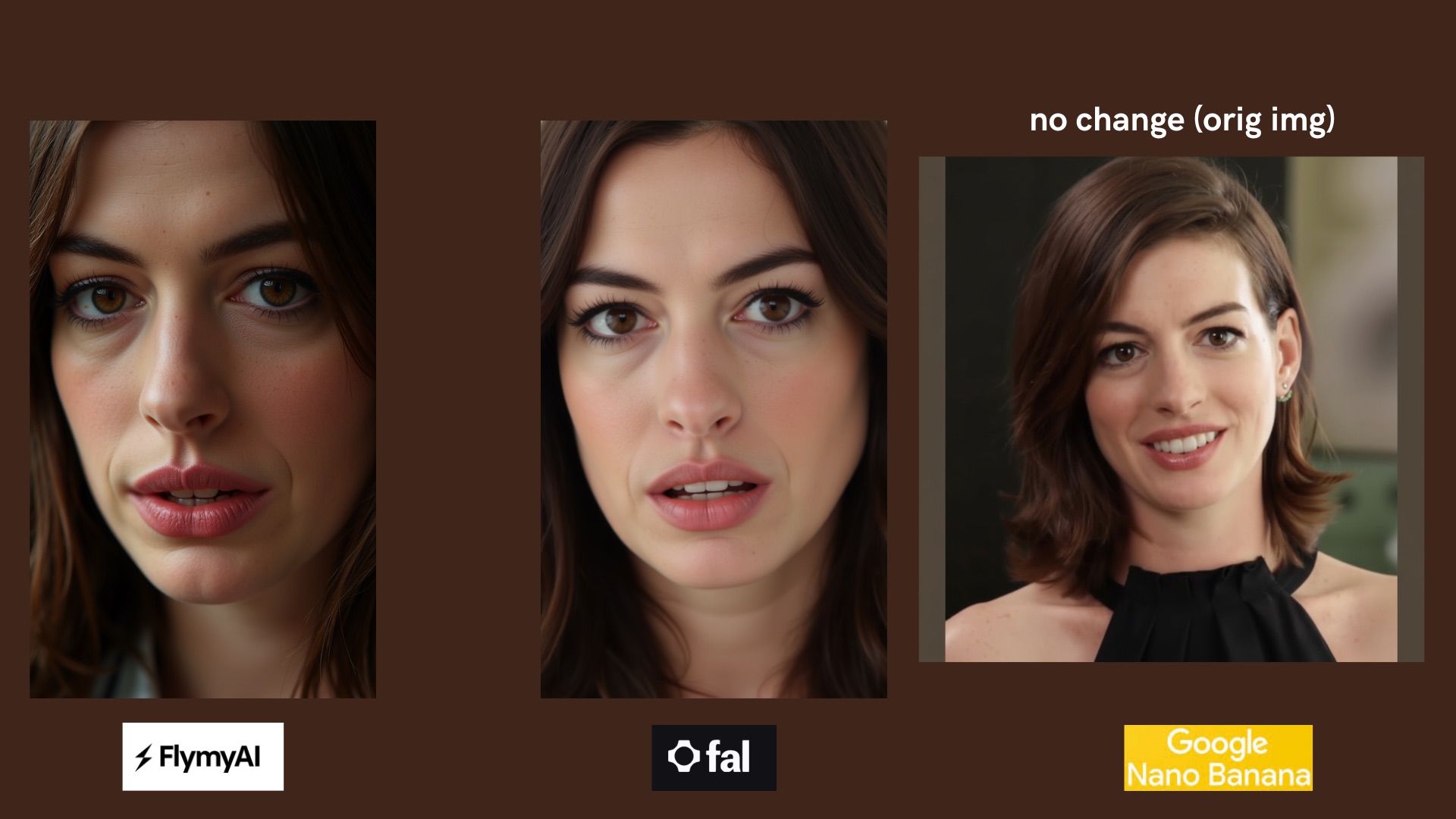
{trigger_word} woman A cinematic close-up of a woman face with light freckles, glossy lips slightly parted, and focused sharp eyes, shot with 85mm lens and shallow depth of field
Fal outputs generate a face that deviates substantially from the original identity, whereas Nano Banana results collapse into a generic appearance with minimal prompt adherence.
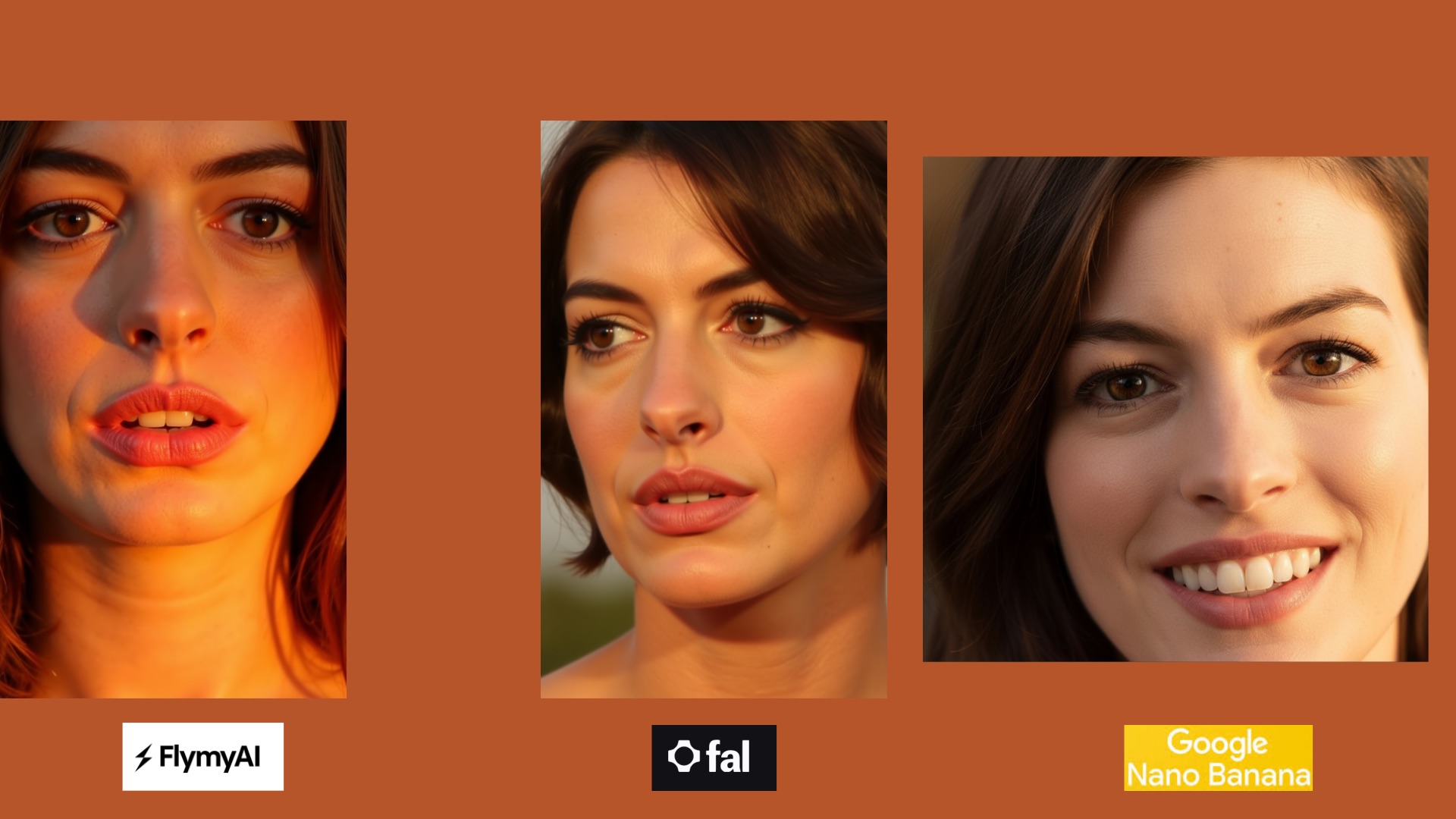
{trigger_word} woman Macro photography style close-up of female face with light makeup, focused on eyes and lips, illuminated by golden hour sunlight for warm tones
Fal results show poor prompt adherence, with lighting that fails to match the specified conditions, while Nano Banana outputs depict a character whose appearance bears little resemblance to the original identity.
Results
Identity fidelity
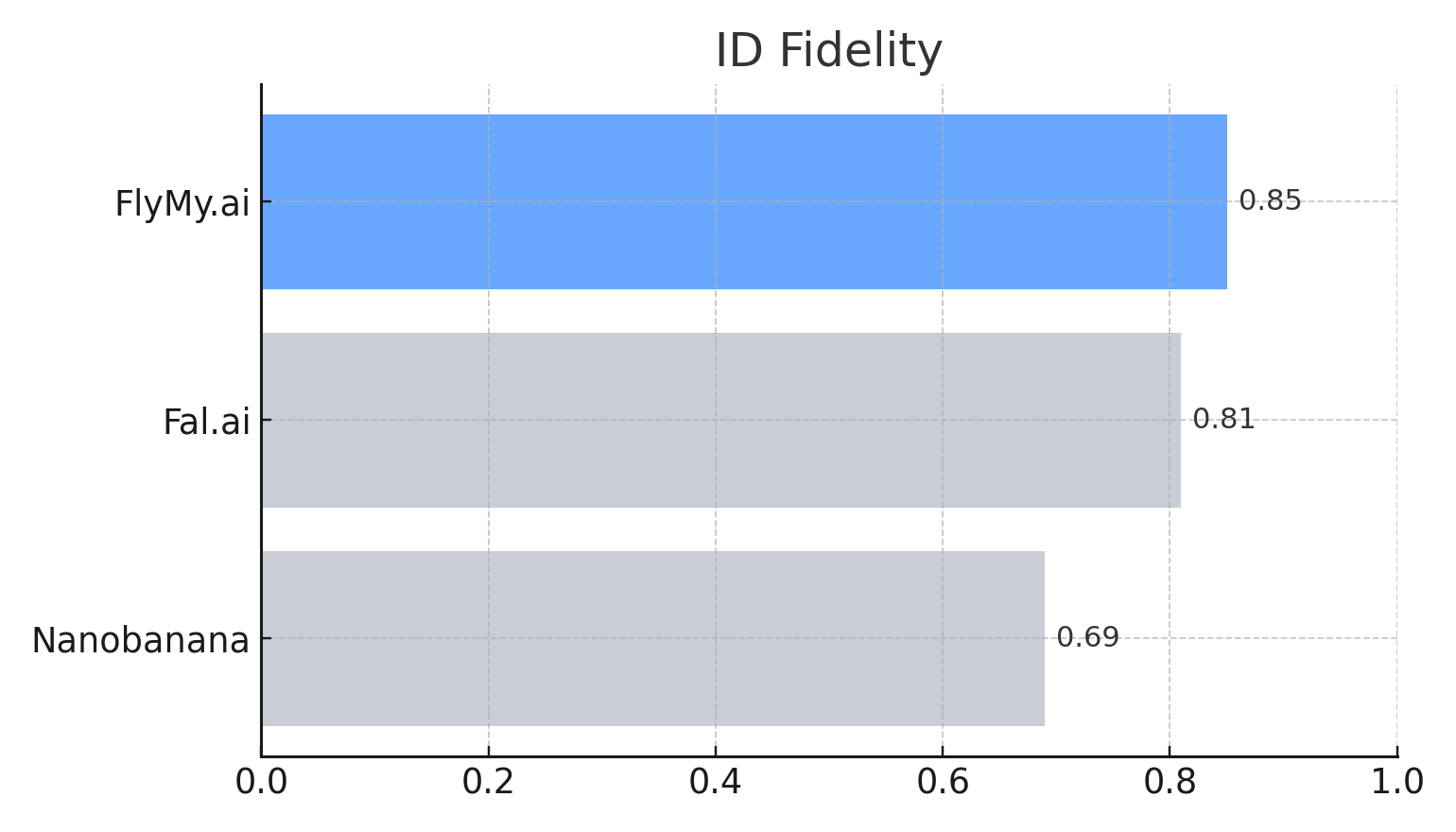
We measure identity fidelity as the similarity between the generated face and the
reference identity (face-embedding cosine across multiple prompts). Higher values
indicate better identity preservation.
0.85
FlyMy.AI
0.81
Fal.ai
0.69
Nano Banana
Identity fidelity across the test set. Higher is better.
Across our test set, FlyMy.AI scores 0.85, outperforming
Fal.ai (0.81) and Nano Banana (0.69). Qualitatively,
FlyMy.AI maintains skull shape, eye geometry and nasal structure more consistently
under strong style shifts (e.g. cyberpunk, vintage poster, street art), while Fal.ai
shows mild drift and Nano Banana exhibits more frequent regression to a generic face.
Prompt adherence
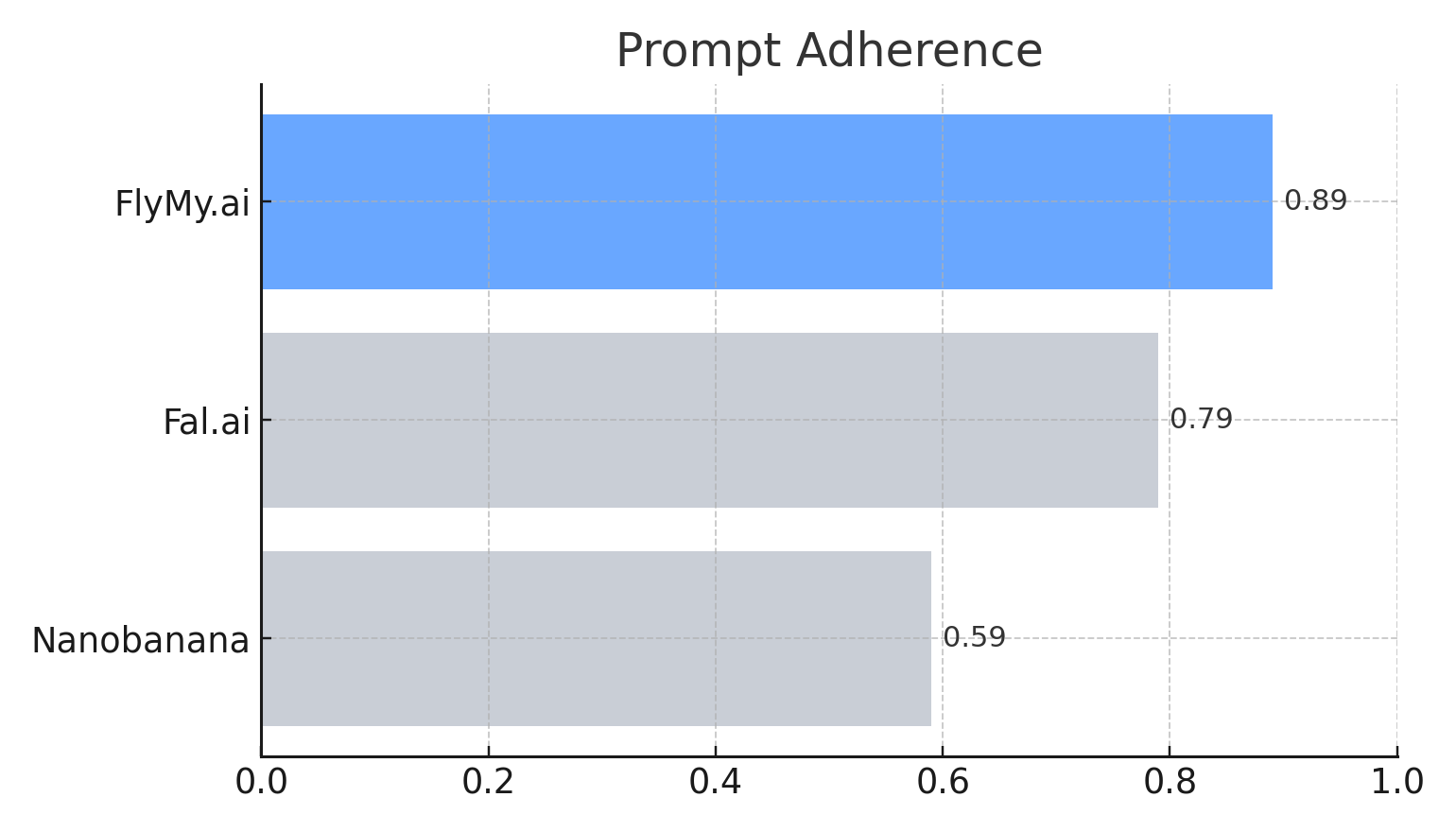
Prompt adherence measures how closely the image follows the textual description -
including scene, style and visual attributes.
0.89
FlyMy.AI
0.86
Fal.ai
0.59
Nano Banana
Prompt adherence on the same set of prompts. Higher is better.
On the same set of prompts, FlyMy.AI achieves 0.89, with
Fal.ai at 0.86 and Nano Banana at 0.59. In practice,
this translates into tighter control of styling, wardrobe and scene elements with
fewer re-runs to "lock in" the intended look.
Fal.ai produced results where the character often lost key facial traits. Across different prompts:
Faces aged inconsistently
Eyes and face shape shifted noticeably
Artifacts appeared more frequently, especially in styled generations
In short: Fal.ai struggles with ID preservation and stability.
Nano Banana: expensive and inconsistent
Nano Banana is another well-known option in this space, but the results showed clear limitations:
Poor consistency across multiple prompts (the same character changes noticeably)
Lower prompt adherence made generations harder to control
Google Nano Banana charges more per generation, making it prohibitively expensive for iterative workflows or large-scale use
FlyMy.AI: stable faces, robust style transfer
FlyMy.AI, on the other hand, showed the most stable identity preservation in this test.
Facial structure and details (skull shape, nose, eyes) remained intact across styles
The model followed prompt instructions reliably, even under strong stylistic changes (cyberpunk, vintage poster, street art, etc.)
Results were both recognizable and highly adaptable
This aligns with our internal focus: building LoRA pipelines that scale efficiently,
maintain character fidelity and deliver value at a lower price point.
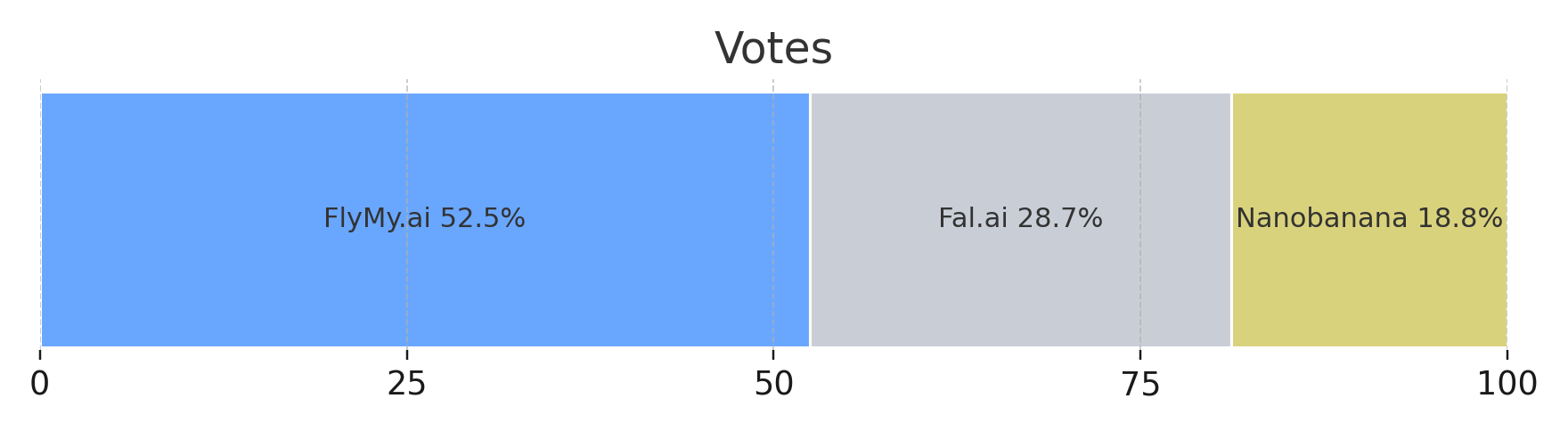
Voting results comparing perceived generation quality across all prompts.
The feedback aligns with our quantitative benchmarks: FlyMy.AI leads with over
half of all votes, while Fal.ai follows at roughly one-third and Nano Banana
trails significantly. Users consistently recognize higher prompt fidelity and identity
stability in FlyMy.AI generations.
Inference parameters
We used standard inference parameters in ComfyUI, setting
FluxGuidance to 4 (slightly higher than default) to encourage stronger
prompt adherence. For KSampler, we set CFG to 1 to
maximize similarity to the reference.
The ComfyUI inference graph used for all Flux + LoRA generations.
Train your own FLUX LoRA
The same trainer we benchmarked here is live on FlyMy.AI - one API call, production speed.